Having a large supplier base has its challenges. Irrespective of whether you are coming at it from a retail, foodservice, wholesale or manufacturer perspective, managing a range of suppliers through a series of complicated approval steps can be daunting.
Specifier technical teams are getting smaller and 1st party audits are time consuming and expensive and, whilst necessary, especially for new suppliers, are only part of the approval process. Many companies rely on a 3rd party audit model to set a food safety baseline such as a GFSI benchmarked scheme (BRCGS, FSSC22K, IFS or SQF for example) or SALSA for micro and smaller suppliers, and then build the process to include an array of self assessment questionnaires and/or a 2nd party scheme, where the specifier can choose their own auditors and set of requirements. Across the whole process and there is duplication and audit burden.
So what’s the answer? Is there a best practice model with the right balance of audits, testing and now, real life analysis of the enormous amount of collected data. The answer is no. Everybody does it differently.
There are many examples of how technical teams use audit information, but most of the time unless it’s a failure or a change in site ownership, nothing much will happen. Even a grade drop may not get the attention it requires.
The main pitfall in supplier approval for food and drink businesses tend to come from treating supplier approval as an administrative exercise rather than a risk-based food-safety and due-diligence process.
Here are 10 common pitfalls we come across at MNGP.
Not taking a risk-based approach – Treating a low-risk packaging supplier in the same way as a raw chicken, dairy or ready-to-eat supplier wastes resources and can leave significant risks unidentified.
Approving suppliers based on paperwork alone – Having a certificate doesn’t necessarily demonstrate that the supplier is consistently controlling food safety, authenticity, allergens or quality. Any certificate can be faked, especially with AI.
Out-of-date certificates and documentation – Supplier approval files often contain expired BRCGS, ISO, organic or other certificates without anyone noticing. MNGP routinely run validation checks across suppliers and often find expired certificates.
Assuming certification equals due diligence – Certification provides excellent evidence, but businesses still need to consider scope, site, products covered, audit status and the actual risks associated with the supplied product. Audit scope comparison can reveal some critical gaps that a brand owner may not be aware.
Poor approval of small or artisanal suppliers -Smaller suppliers may not have third-party certification, but that doesn’t automatically make them unsuitable. The mistake is either rejecting them unnecessarily or approving them without compensating controls.
Weak allergen controls – Supplier approval doesn’t always properly verify allergen management, cross-contact controls, cleaning, labelling and changes to allergen status.
Insufficient product specifications – A supplier may be approved while specifications are incomplete or missing critical information such as ingredients, allergens, microbiological criteria, country of origin, shelf life, storage conditions, legal/claims requirements and packaging requirements.
Failure to manage supplier changes – Changes to ingredients, manufacturing sites, processes, ownership, raw materials or subcontractors can introduce new risks without triggering a supplier re-approval.
Not monitoring supplier performance – Approval should be the start of the relationship, not the end. Complaints, non-conformances, rejected deliveries, late documentation, recalls and testing results should feed into supplier risk ratings.
No clear escalation or re-approval process – Businesses sometimes don’t know when a supplier should move from approved to conditional or suspended. There should be defined triggers and responsibilities.
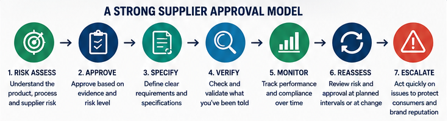
The biggest underlying problem is that supplier approval is often a document-collection exercise rather than an ongoing assessment of food safety and supply-chain risk. A better model could be based on the example below.
Technical Assurance, Business Confidence
Contact Email: team@mngp.co.uk for more information or complete the form below