Having a large supplier base has it’s challenges. Irrespective of whether you are coming at it from a retail, foodservice, wholesale or manufacturer perspective, managing a range of suppliers through a series of complicated approval steps can be daunting.
Technical teams are getting smaller and 1st party audits are time consuming and expensive and, whilst necessary, especially for new suppliers, are only part of the approval process, many companies rely on a 3rd party audit model to set a baseline such as a GFSI benchmarked scheme (BRCGS, FSSI, IFS, SQF for example) or SALSA for micro and small suppliers and then build the process to include an array of self assessment questionnaires, 2nd party scheme where the specifier can choose their own auditors and the set of requirements that ends up duplicating many areas already covered.
So what’s the answer? Is there a best practice model with the right balance of audits, testing and now, real life analysis of the enormous amount of collected data. The answer is no. Everybody does it differently.
I can give you many examples of how technical teams use audit information, but most of the time unless it’s a failure or a change in site ownership, nothing much will happen.
What I do know is that the main pitfalls in supplier approval for food and drink businesses tend to come from treating supplier approval as an administrative exercise rather than a risk-based food-safety and due-diligence process.
Here are 10 common pitfalls we come across at MNGP.
Not taking a risk-based approach – Treating a low-risk packaging supplier in the same way as a raw chicken, dairy, allergen or ready-to-eat supplier wastes resources and can leave significant risks unidentified.
Approving suppliers based on paperwork alone – Having a certificate doesn’t necessarily demonstrate that the supplier is consistently controlling food safety, authenticity, allergens or quality.
Out-of-date certificates and documentation – Supplier approval files often contain expired BRCGS, ISO, organic, allergen or other certificates without anyone noticing.
Assuming certification equals due diligence – Certification is useful evidence, but businesses still need to consider scope, site, products covered, audit status and the actual risks associated with the supplied product.
Poor approval of small or artisanal suppliers -Smaller suppliers may not have third-party certification, but that doesn’t automatically make them unsuitable. The mistake is either rejecting them unnecessarily or approving them without compensating controls.
Weak allergen controls – Supplier approval doesn’t always properly verify allergen management, cross-contact controls, cleaning, labelling and changes to allergen status.
Insufficient product specifications – A supplier may be approved while specifications are incomplete or missing critical information such as ingredients, allergens, microbiological criteria, country of origin, shelf life, storage conditions, legal/claims requirements and packaging requirements.
Failure to manage supplier changes – Changes to ingredients, manufacturing sites, processes, ownership, raw materials or subcontractors can introduce new risks without triggering a supplier re-approval.
Not monitoring supplier performance – Approval should be the start of the relationship, not the end. Complaints, non-conformances, rejected deliveries, late documentation, recalls and testing results should feed into supplier risk ratings.
No clear escalation or re-approval process – Businesses sometimes don’t know when a supplier should move from approved to conditional or suspended. There should be defined triggers and responsibilities.
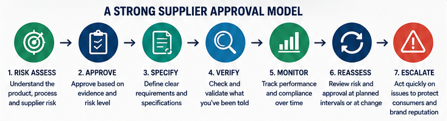
The biggest underlying problem is that supplier approval is often a document-collection exercise rather than an ongoing assessment of food safety and supply-chain risk. A better model could be the shown below.
Technical Assurance, Business Confidence